What Is the Maya Calendar? A Beginner’s Guide to the Maya Calendar System
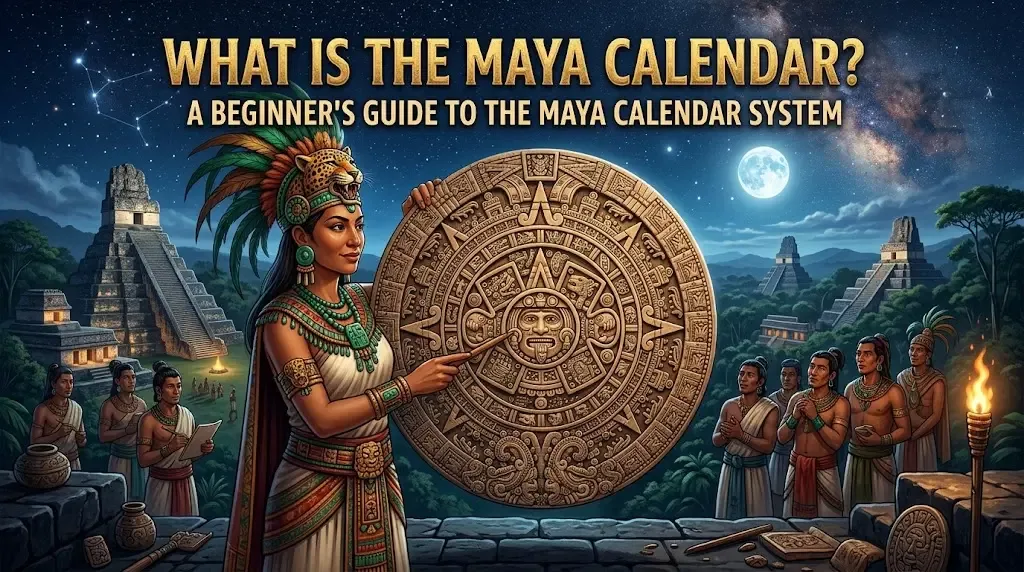
The Maya Calendar is one of the most fascinating calendar systems ever developed in the ancient world. Created and refined by Maya civilizations in Mesoamerica, it was used to organize religious ceremonies, agricultural activities, political events, and important moments in everyday life.
Unlike the modern Gregorian calendar, which uses a single system of months and years, the Maya calendar tradition consisted of several interconnected calendar cycles. The most important were the Tzolk’in, a 260-day ritual calendar, and the Haab’, a 365-day solar calendar.
Together, these cycles created a much more complex way of understanding time.
The Maya Did Not Have Just One Calendar
When people hear the phrase “Maya Calendar,” they often imagine a single ancient calendar counting the days of a year.
In reality, the Maya developed several different systems for measuring time.
The two most important cycles were:
Tzolk’in — a 260-day sacred or ritual cycle
Haab’ — a 365-day solar cycle
Calendar Round — a larger cycle created by combining the Tzolk’in and Haab’
Long Count — a system used to record long periods of historical time
These systems served different purposes, but they were closely connected.
This is one of the reasons Maya timekeeping can seem complicated at first. Rather than thinking of time as a straight line divided only into months and years, the Maya used overlapping cycles.
What Is the Tzolk’in?
The Tzolk’in is a 260-day cycle and is one of the most important elements of the Maya calendar tradition.
It combines two repeating sequences:
20 day names
13 numbers
The numbers cycle from 1 to 13, while the 20 day names cycle continuously.
Because 13 and 20 combine without repeating the same combination until 260 days have passed, the system produces 260 unique day combinations.
For example, a day might be represented by a number and a day name. The next day would have a different combination, and the sequence would continue until the complete 260-day cycle was completed.
The Tzolk’in was particularly important for ritual and ceremonial purposes. In traditional Maya cultures, particular days could carry different meanings and associations.
What Is the Haab’?
The Haab’ is a 365-day solar calendar.
It is somewhat similar to the modern concept of a solar year because it follows the approximate length of Earth's journey around the Sun.
The Haab’ consists of:
18 periods of 20 days each
One additional period of 5 days
This gives:
18 × 20 + 5 = 365 days
The 5-day period at the end of the year was known as Wayeb’.
The Haab’ was useful for agricultural activities, seasonal changes, ceremonies, and other events connected with the solar year.
However, unlike the modern Gregorian calendar, the traditional Haab’ did not use a leap-year system to keep its calendar perfectly synchronized with the tropical year.
The Calendar Round: When Two Calendars Meet
The Tzolk’in and Haab’ were not independent systems.
They could be combined to create a larger cycle known as the Calendar Round.
Because the Tzolk’in contains 260 days and the Haab’ contains 365 days, the same combination of a Tzolk’in date and a Haab’ date does not repeat every year.
Instead, it takes approximately 52 Haab’ years, or about 18,980 days, for the same combination to occur again.
This period is known as a Calendar Round.
For the ancient Maya, this provided a way to identify dates within a repeating cycle that was much larger than a single year.
What Is the Maya Long Count?
The Calendar Round was excellent for identifying recurring dates, but it had an important limitation.
A particular Calendar Round date would eventually repeat.
So how could the Maya record an event that happened hundreds or thousands of years earlier?
This is where the Long Count comes in.
The Long Count is a system for counting elapsed days from a fixed starting point. Instead of simply giving a date within a repeating calendar cycle, it provides a numerical representation of how many days have passed since the beginning of a particular era.
The basic Long Count units include:
Kin — 1 day
Uinal — 20 days
Tun — 360 days
Katun — 7,200 days
Baktun — 144,000 days
This system allowed Maya scribes to record dates over very long periods.
It was especially important in historical inscriptions found on monuments, stelae, temples, and other archaeological sites.
Why Did the Maya Have Such a Complex Calendar?
For the Maya, measuring time was not simply about knowing what day it was.
Time was deeply connected with religion, astronomy, agriculture, political power, and ceremonial life.
Maya civilizations carefully observed celestial phenomena, including the movements of the Sun, Moon, and planets. Their calendars helped organize important events and provided a framework for understanding recurring patterns in the natural and sacred world.
Dates were also important in political inscriptions.
Maya rulers frequently recorded accessions, military events, ceremonies, dynastic history, and other important occasions using calendar dates.
In this sense, the Maya calendar was not merely a method of measuring time.
It was part of the structure through which Maya societies understood history and the world around them.
Is the Maya Calendar the Same as the Aztec Calendar?
No.
The Maya and Aztec civilizations developed in different historical and cultural contexts, although they shared certain broader Mesoamerican traditions.
The Aztec calendar system is often represented by the famous Aztec Sun Stone, while Maya inscriptions provide extensive evidence of systems such as the Tzolk’in, Haab’, and Long Count.
There are similarities between some Mesoamerican calendar traditions, particularly the existence of a 260-day ritual cycle, but the Maya calendar should not simply be treated as another name for the Aztec calendar.
Did the Maya Predict the End of the World?
Probably the most famous modern misunderstanding about the Maya calendar concerns December 21, 2012.
Some people believed that the completion of a major Long Count cycle meant that the Maya had predicted the end of the world.
That interpretation was not supported by the surviving Maya inscriptions.
The date corresponded to the completion of a major cycle in the Long Count, but the completion of a cycle does not necessarily mean the end of time.
A useful modern analogy would be an odometer reaching a significant number and then continuing to count.
Maya inscriptions also contain evidence that Maya people thought about dates far beyond 2012, which makes the idea of a predicted apocalypse especially difficult to support.
Is the Maya Calendar Still Used Today?
Yes.
The Maya calendar is not simply an archaeological curiosity.
Maya communities still exist throughout parts of Mexico, Guatemala, Belize, Honduras, and other regions of Mesoamerica, and traditional calendar practices continue to have cultural and ceremonial importance in some communities.
Modern interest in the Maya calendar has also expanded beyond academic archaeology.
Today, people encounter Maya calendar concepts through:
archaeology
anthropology
history
spirituality
astrology and divination
modern Maya cultural traditions
personal calendar and self-discovery systems
However, it is important to distinguish between historical Maya calendrical systems and modern spiritual interpretations that have developed much more recently.
The Maya Calendar and Modern Spiritual Practice
The Tzolk’in has attracted considerable interest among people who are interested in symbolism, spirituality, and personal development.
Modern systems may associate particular calendar days with specific qualities, themes, symbols, or archetypes.
These approaches can be interesting ways to explore the symbolism of the Maya calendar, but they should not automatically be presented as identical to the historical practices of ancient Maya civilizations.
Understanding this distinction is important.
The historical Maya calendar is supported by archaeological evidence, inscriptions, manuscripts, and research into Maya culture. Modern spiritual interpretations are newer frameworks that may draw inspiration from Maya calendrical traditions while developing their own methods of interpretation.
Why Is the Maya Calendar Still Fascinating?
Perhaps the most remarkable thing about the Maya calendar is the way it combines mathematics, astronomy, history, religion, and culture into an interconnected system.
The Maya did not simply count days.
They created multiple cycles that interacted with one another, allowing them to organize ritual time, solar seasons, historical events, and enormous spans of time.
And this is exactly what makes the Maya calendar worth studying today.
It gives us a glimpse into a civilization that developed sophisticated ways of thinking about time long before modern clocks and digital calendars existed.
A Simple Way to Understand the Maya Calendar
If you are completely new to the subject, you can think about the major systems like this:
Tzolk’in → 260-day sacred cycle
Haab’ → 365-day solar cycle
Calendar Round → Tzolk’in + Haab’
Long Count → long-term counting of elapsed days
Once these four concepts are understood, the Maya calendar becomes much less mysterious.
It is not one complicated calendar.
It is a collection of interconnected systems designed to describe different dimensions of time.
Explore the Maya Calendar
The Maya calendar is much more than a historical artifact.
It represents one of the most sophisticated approaches to timekeeping developed in the ancient Americas, and its influence can still be seen in Maya communities and in modern interest in Maya calendrical traditions.
If you are beginning to explore the subject, learning the 20 day signs, the 13 numbers of the Tzolk’in, the 260-day cycle, and the relationship between the Tzolk’in and Haab’ is a good place to start.
From there, the world of Maya calendrical symbolism becomes much easier to understand.